
STGB vs. Memoria Press
A Comparison of Curricula

Study The Great Books is the new kid on the block when it comes to classical Christian curriculum houses. Memoria Press, Veritas Press, Roman Roads Press, and several other well known companies have been around quite a bit longer than we have (not to mention the fact they all have the word “Press” in their name so we are really the oddball). It would be reasonable to ask, therefore, “Why does Study The Great Books think that there is any need for another classical Christian curriculum house?” Well, it’s a fine question and this is the first post in a series where I plan to justify STGB’s existence. We think we are offering something that goes above and beyond, even as we stand on the shoulders of those who came before us.
In this series I plan to compare and contrast the History and Literature curricula of some of the other well-known classical Christian curriculum companies (particularly their 7-12 grade materials) against the Study The Great Books approach. At a later date I may do a similar analysis of the competing Logic and Rhetoric curricula available, but since STGB is still a few years from entering that fray in earnest with our own publications we will stick to Literature and History materials for now. I mean for these posts to highlight our attempt to be competitive alongside other excellent companies, but I am not seeking to be combative. It is a principle of the Free Market that competition breeds excellence and, at STGB, we are working hard to produce a superior product and we welcome the competition. May we all continue to outdo one another as we seek to equip the body of Christ with the finest educational materials possible.
For this first post I want to compare STGB’s approach to History and Literature with Memoria Press’.
Memoria Press
On a personal note, Memoria Press was the primary curriculum that my wife and I used when we homeschooled our four children during the early years of their education. It’s great material and far more affordable than some other programs. I still regularly promote Memoria Press to homeschooling families, especially those with children in K-6. Martin Cothran, the editor of Memoria Press’ Classical Teacher magazine, author of various parts of their curriculum, and provost of Memoria College (which is a super cool program) is someone I highly respect and enjoy talking to each summer at the Repairing the Ruins conference. All-in-all, Memoria Press is a great curriculum house and we honor them and their contribution to the great work of restoring education in America.
Division of Curriculum
Memoria Press’ approach to History and Literature is broken up differently than we do it at STGB. They divy up their study of History and Literature books into categories like Classical Studies, Christian Studies, and Literature and Poetry whereas we prefer to have blurrier lines between subjects and emphasize to students that all areas of learning flow in and out of one another. That point is one which I would assume that Memoria Press agrees with, by the way, but we are organizing our material in such a way as to intentionally promote the unity of all learning as opposed to separate subjects.
Another point of differentiation between STGB and Memoria seems to be that Memoria’s approach to reading Literature by grade does not strictly follow a temporal progression. For instance, if you were to order their pre-packaged 9th grade curriculum you would be getting The Aeneid, Beowulf, A Midsummer Night’s Dream, and The Hound of the Baskervilles among other pieces of literature. All excellent pieces, but nevertheless a scatter-shot across the ancient, medieval, and modern time periods. STGB, on the other hand, follows a progression like so:
Logic Grades 7th-9th
7th grade History and Literature covering the time span from Creation of the world to the Incarnation of Christ.
8th grade History and Literature covering the time span from the Incarnation of Christ to the Reformation of the church.
9th grade History and Literature covering the time span from the Reformation of the church to present day.
Rhetoric Grades 10th-12th
10th grade
Humane Letters A: Round two of History and Literature covering the time span from Creation to Incarnation of Christ.
and
Syntopical Seminar A: A year long seminar studying the seven virtues through great literature.
11th grade
Humane Letters B: Round two of History and Literature covering the time span from the Incarnation of Christ to the Reformation of the church.
and
Syntopical Seminar B: One quarter studying the Arts, one quarter studying Education, and one whole semester on society and politics all through reading Great Books.
12th grade
Human Letters C: Round two of History and Literature covering the time span from the Reformation of the church to present day.
Syntopical Seminar C: A year long literary seminar on Faith and Reason.
Our final curriculum plan is still a bit malleable at present while it is still under construction, but you can get the gist of where we are going with it by looking HERE.
We believe that this intentional progression will help students form in their mind a better sense of the flow of history, the interconnectedness of all knowledge and learning, and it will help drive the studies of that year towards a clear objective. We also do not divide biblical and Christian history from history in general and we spend a lot of time in the Christian Scriptures and early church documents as a central part of the student’s moral, theological, philosophical, and historical education.
Though we are still in the midst of building our curriculum, in the long term STGB plans to sell both complete packages of our curriculum, by year and course, as well as giving families, schools, and individuals the option to purchase curriculum pieces and study guides separately so they can pick and choose as they like. We are simply putting together a robust plan to follow for those who are looking for such guidance and we think we have a great plan in the works!
Curriculum Samples
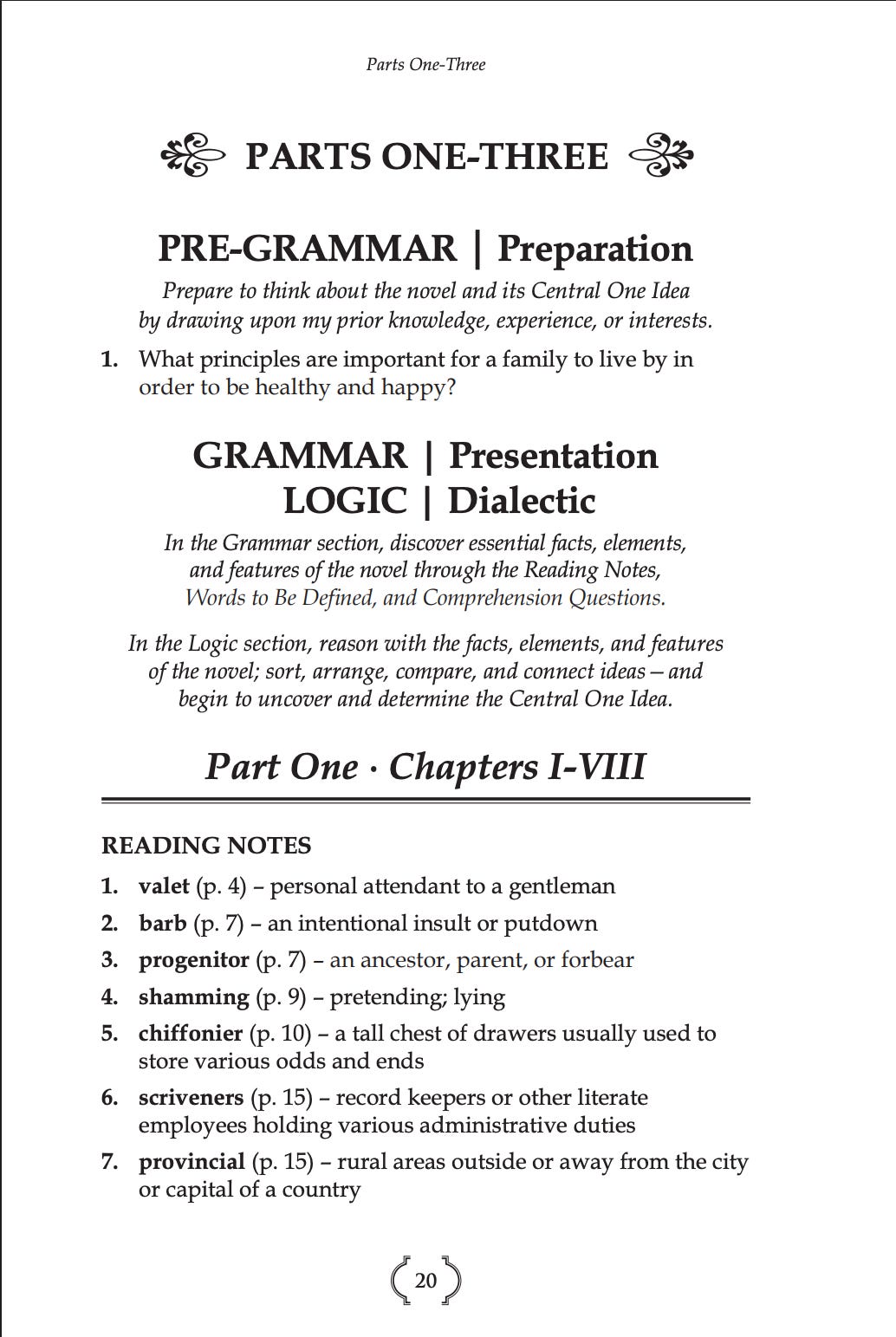
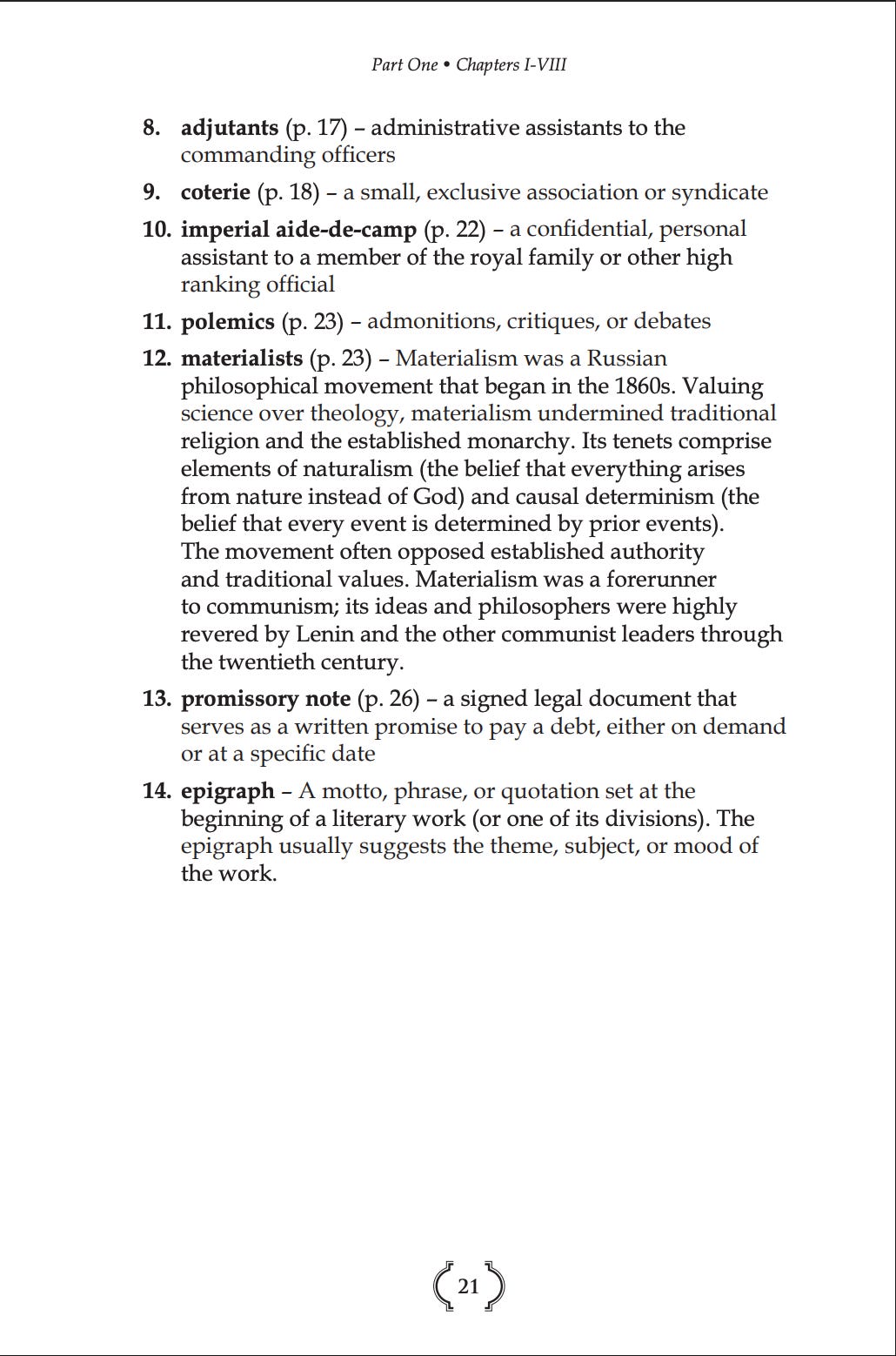
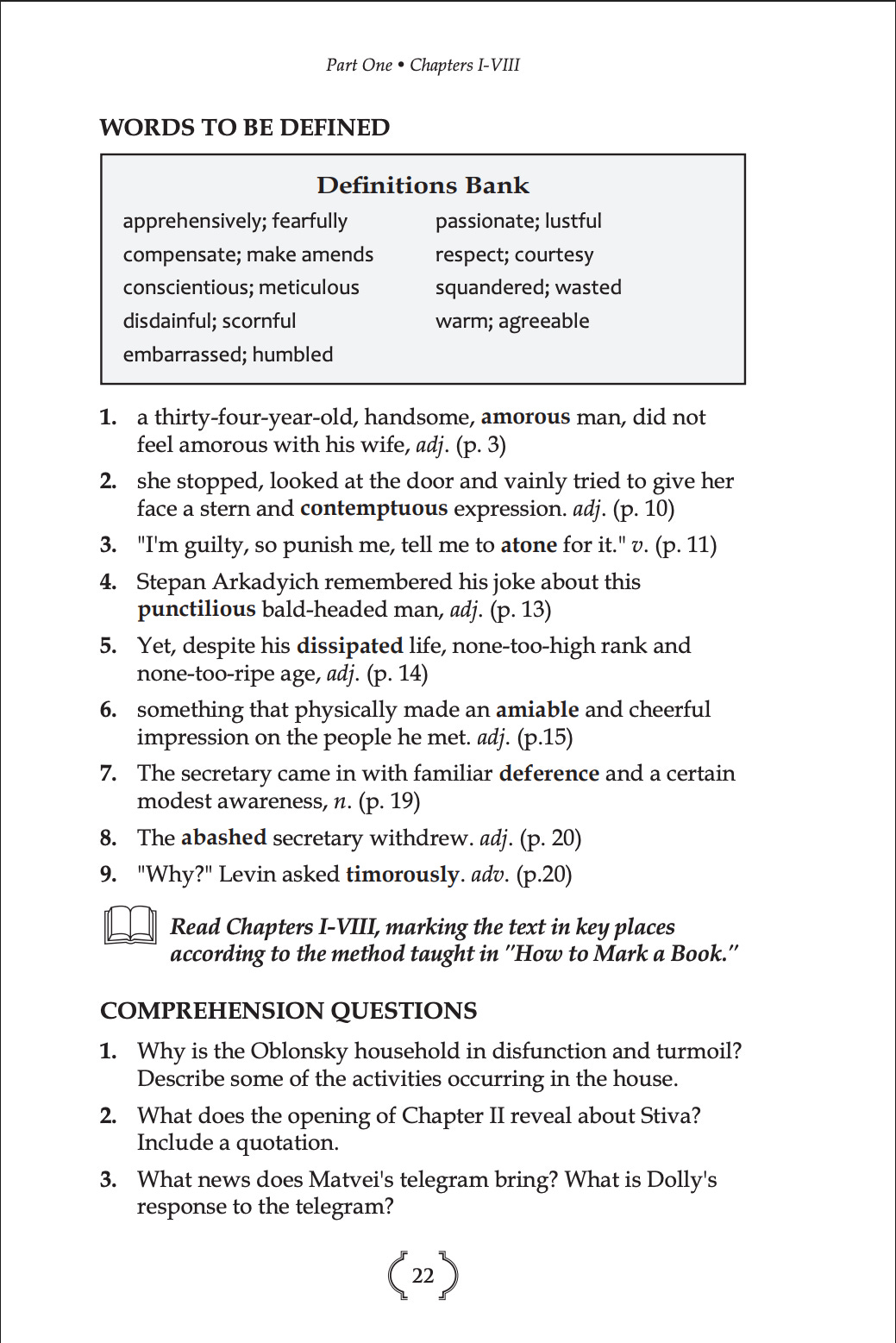
Let’s get in the weeds a bit and look at a sample from Memoria Press’ Literature curriculum alongside one of our guides. The following is a sample lesson from Memoria Press’ Anna Karenina student study guide.***
***Apparently Memoria Press also has a Sir Gawain study guide. That would have been the better one for me to compare here, but I didn’t know it existed. You can look at a sample of it HERE.
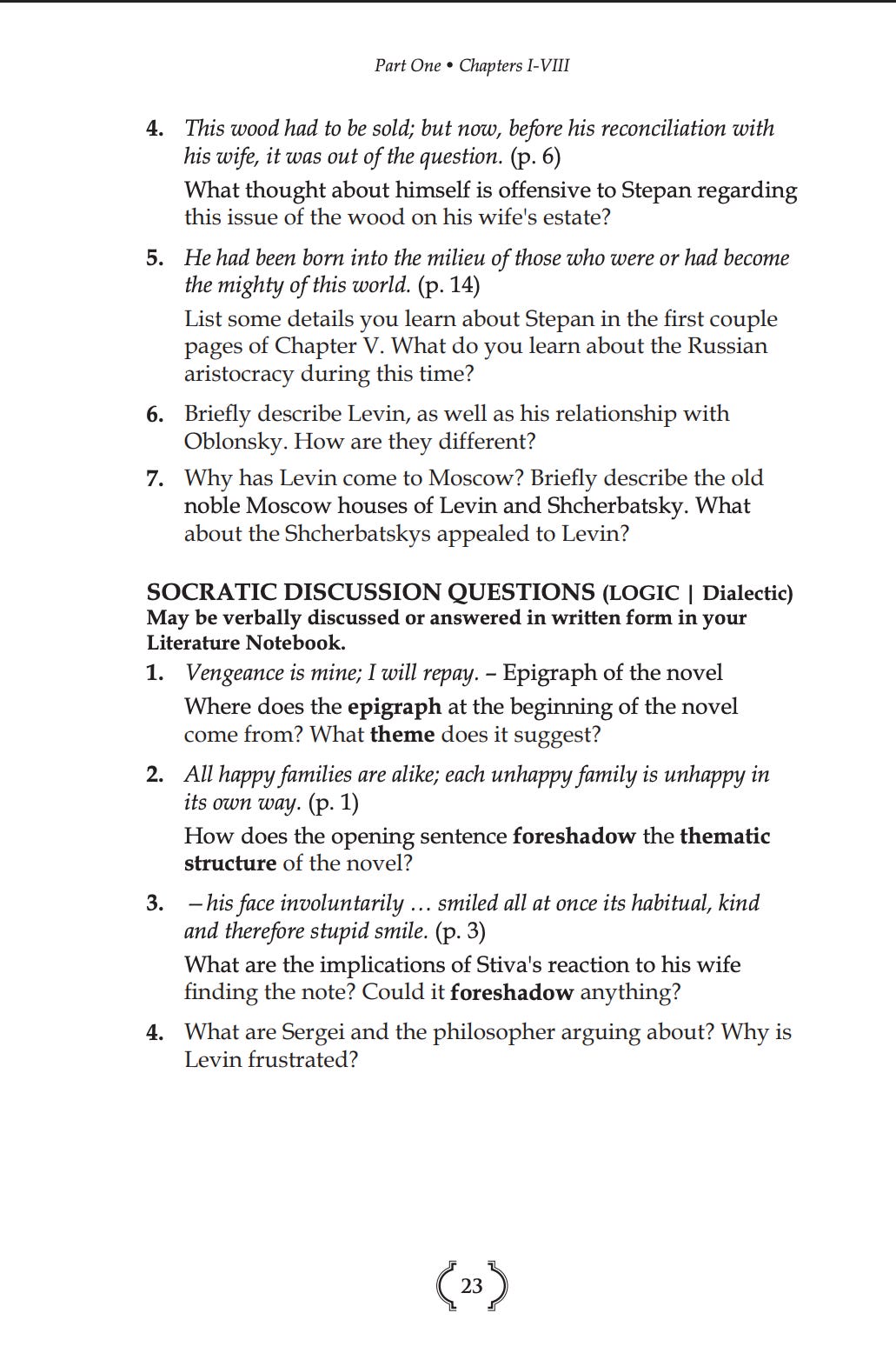
Now let’s take a look at an STGB Study Guide. The following is from our Sir Gawain and the Green Knight study guide.
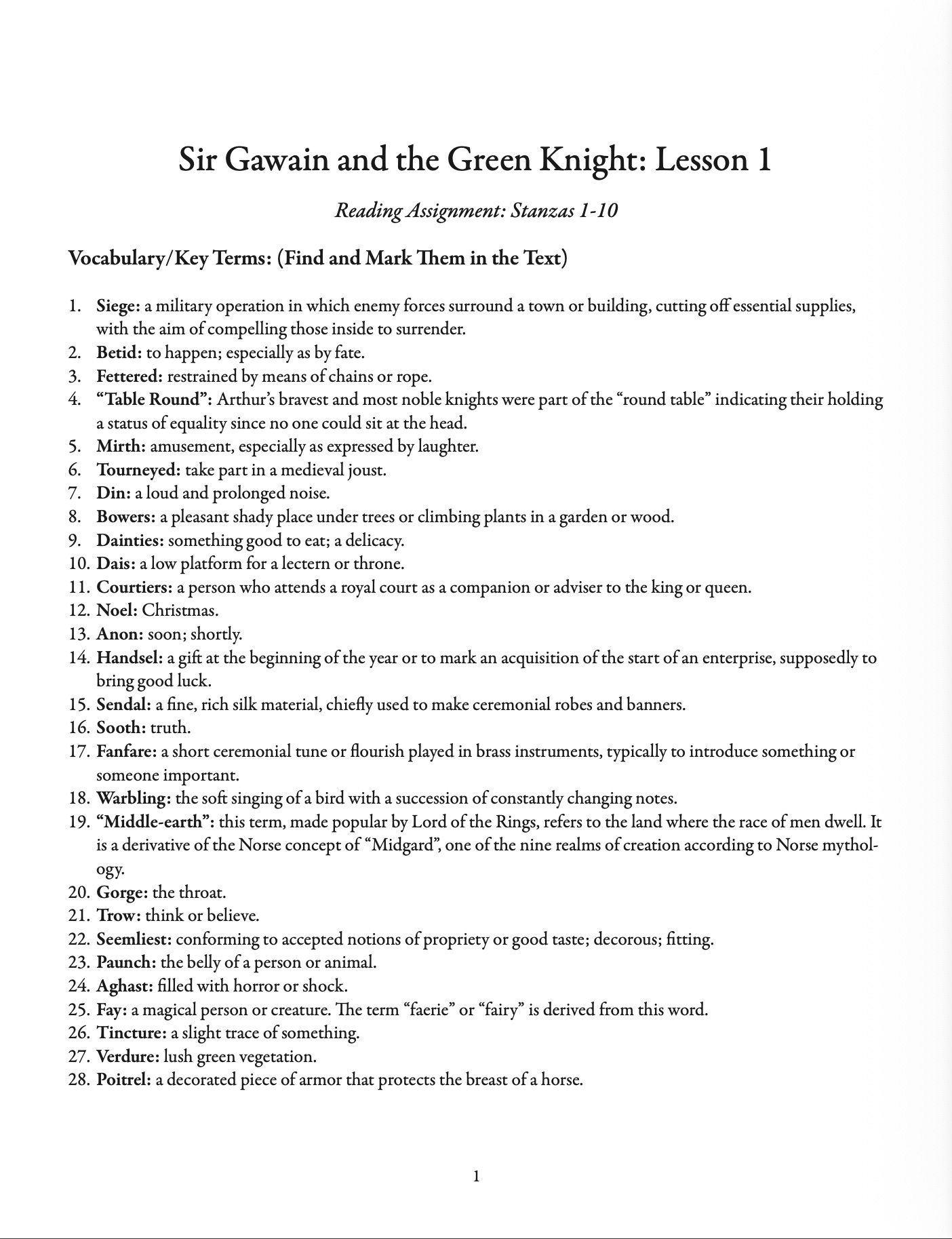
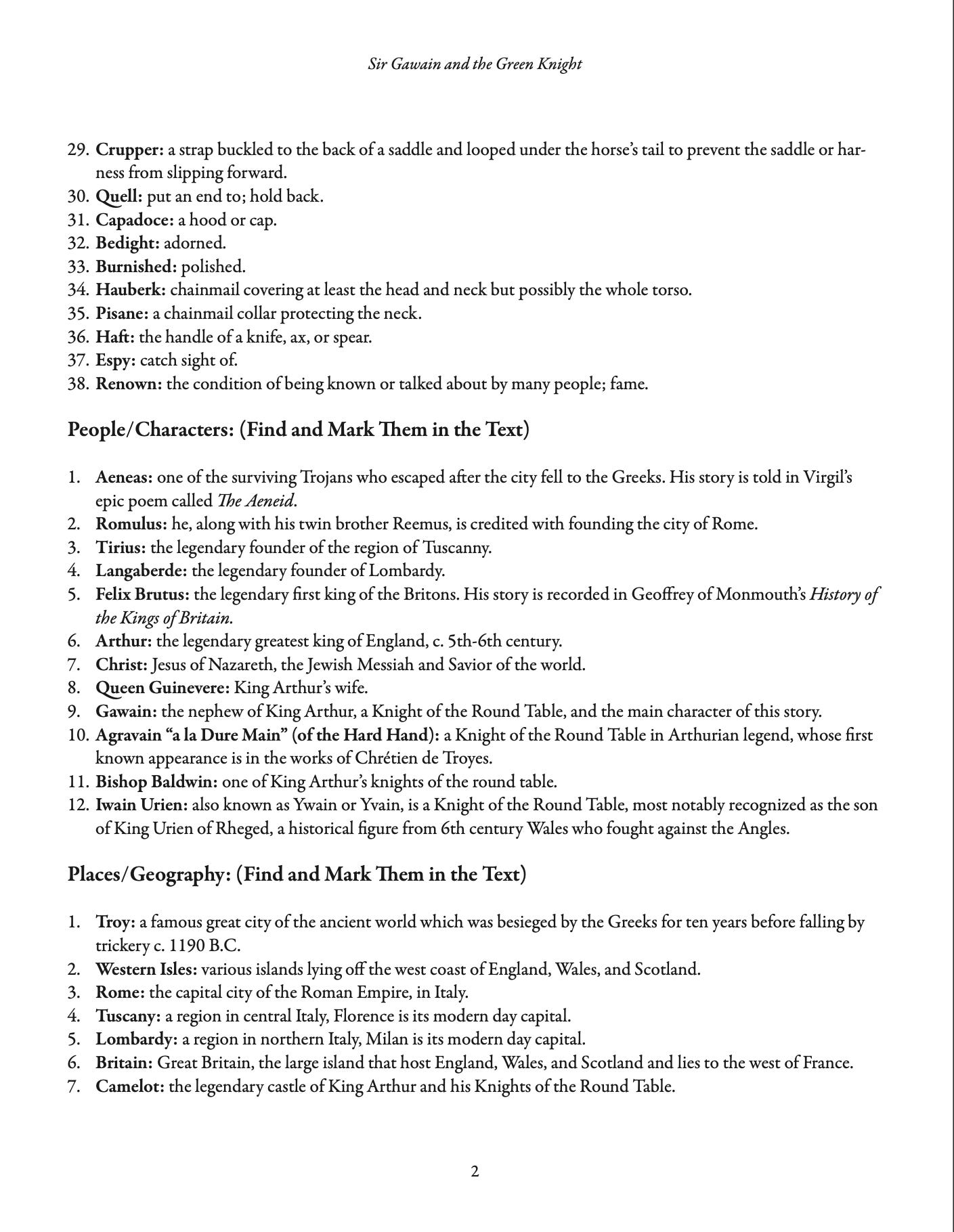
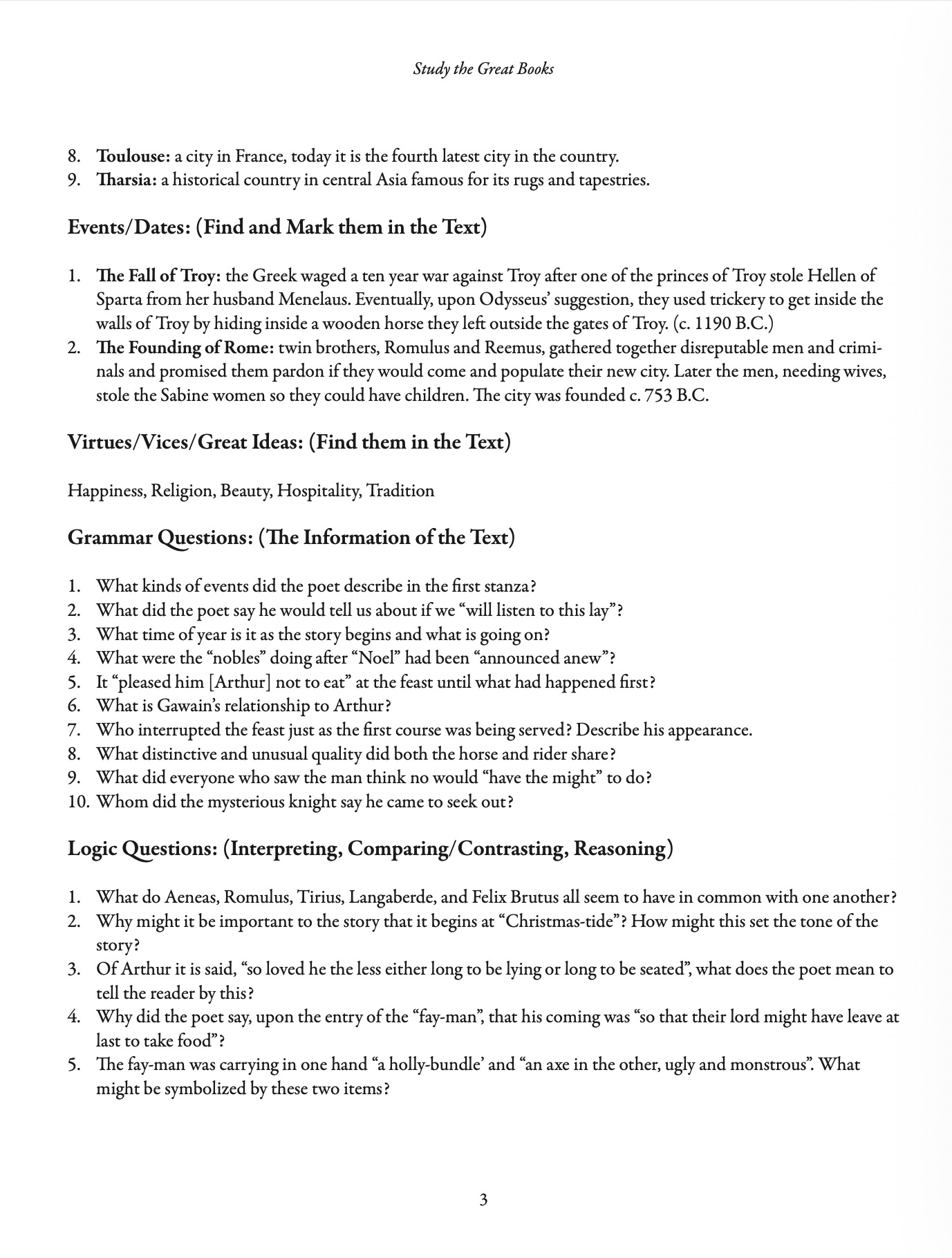
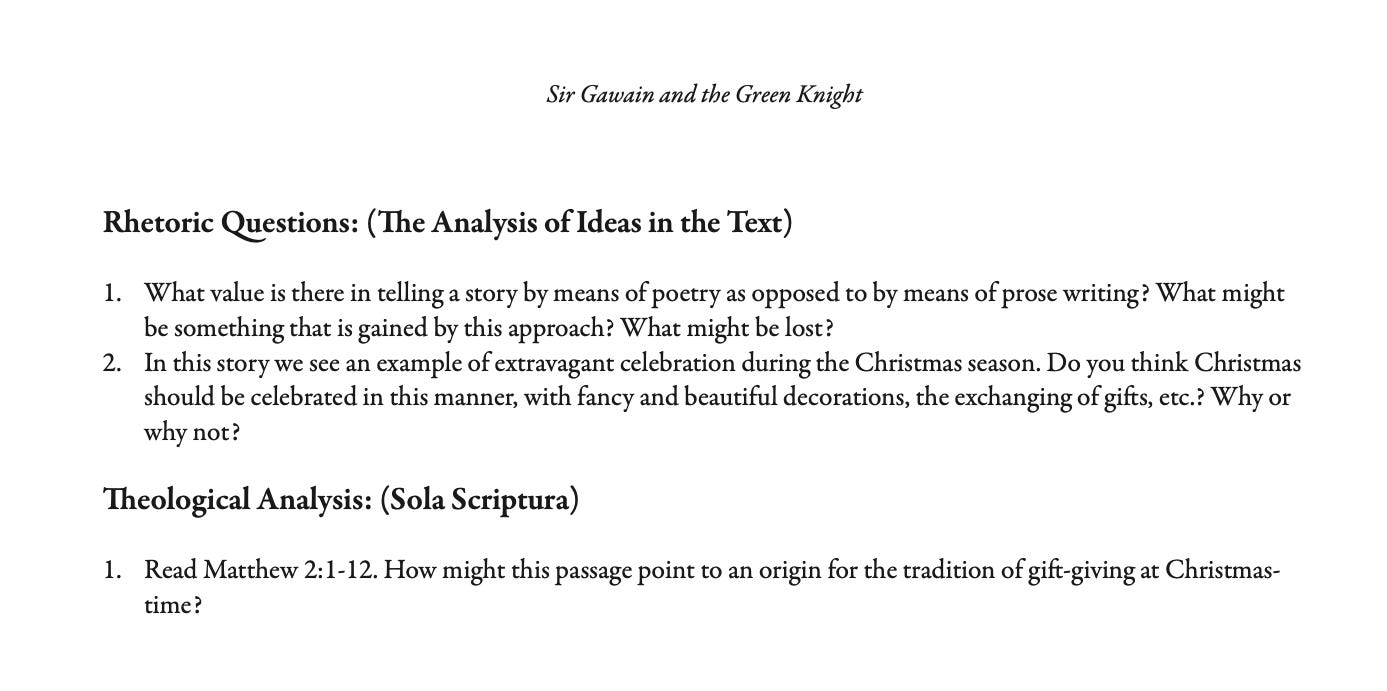
A few things stand out in comparison between STGB and Memoria study guides. For one, Memoria likes to ask a “Pre-Grammar” question, which is to say a “Pre-reading” question. This gives students something to be thinking of before they begin their reading. I like that, honestly, it’s a cool feature of their approach. Another feature of Memoria Press’ guides is that they provide some “reading notes” which are basically definitions for terms or other helpful tidbits to help the student understand difficult or unfamiliar things in the text. They then ask the student to figure our the correct definition of some words or terms based upon context. This latter part is a good skill, I respect this move as well, but STGB has preferred to simply define all vocabulary which we think is either critical to understanding the text or which is likely to be unfamiliar to the student. We think helping the student to quickly understand what they are reading is key to their enjoyment of these Great Books and the love of reading Great Books is a major goal of our curriculum. Struggle is important, but we prefer for that struggle energy to be applied primarily to wrestling with the ideas of a text rather than the vocabulary. Again, simply a choice we have made that we find has been helpful in our experience.
Conspicuously absent in Memoria Press’ guides, by comparison to our own, is the lack of information about Characters or Historical People, Places or Geography, and Events mentioned in the text. We have tried to give the student everything he needs to understand the text so he is not lost and can quickly gain informational context and enjoy what he is reading. We also think this often leads to rabbit trails of interest that may lead the student to begin exploring on their own (often connecting them to other Great Books).
Another detail present in the STGB Study Guides, which is not in the Memoria Press guides, is a list of Great Ideas, Virtues, and Vices which can be found in the reading. We encourage students to always be on the lookout for these when they are reading, to note them in the margins of their book, and to add them to their Commonplace.
Picking back up with Memoria Press’ approach, once their guide is done with matters of definition they then move on to what they call “comprehension questions.” These are equivalent to STGB’s “Grammar Questions” and they ask, simply, “what is the case” about the text. These are who, what, where, and when type questions (“why” questions too, if the text explicitly explains the “why”). Memoria has chosen to include some page numbers to help students find the answers more quickly, we have opted not to do this. The reason why we don’t do this is because we strongly emphasize the practice of annotating books and we have developed a complete system for students to use. If students annotate faithfully then finding the answers to our Grammar Questions is usually fairly easy.
After the “Comprehension Questions” the Memoria Press guides move on to “Socratic Discussion Questions” which are fairly equivalent to what our guides call “Logic Questions,” which are interpretive in nature. Our study guides ask interpretative questions (“what does the text mean when it says…”), but also we sometimes ask students to compare and contrast what they are currently reading with earlier parts of the text and to infer possibilities in light of the textual information.
Our study guides also have two additional categories of questions which are not found in the Memoria Press guides, namely, Rhetoric Questions and Theological Questions. Our Rhetoric questions ask students to analyze an idea which is found in the text and to express their own thoughts, with reason, about the matter. Theological questions refer the student to a passage in the Christian Scriptures which interacts with similar ideas or themes as found in the present reading assignment of their book and asks them to explain how the Scriptures come to bear on those ideas or themes.
What should be evident, by comparison, is that STGB’s Study Guides are simply more comprehensive in nature that Memoria Press’ guides. We put more information at the fingertips of students and teachers to aid their comprehension and enjoyment of the text. We have provided more questions (and more varied in kind) to help students and teachers explore different and various angles of the reading. Further, our Study Guides are keyed to specifically work with our annotation system and Commonplace system.
Now, one could argue that the STGB guides have too many questions to actually assign to students and this may be true, but it depends. Our guides are designed to work equally well for Homeschooling Families, Classical Christian Schools, Individual Learners, and community Book Clubs (and have been successfully field tested in all of those contexts). The STGB Study Guides should be thought of as Tool Kits which can be used in a lot of different ways (I address this in more depth in another article called A Word to Teachers), but one shouldn’t feel wedded to the concept of assigning every question in every lesson. On the other hand, if I am using a Memoria Press guide with my students then I am far more likely to assign all or most of the questions because they are more sparse.
What else might be said in comparison between STGB and Memoria Press? STGB’s curriculum is completely written by two people working closely together. I am the main curriculum developer and my wife, Susan Allee, is also involved in writing some of our guides. I have a Ph.D. in Humanities from Faulkner University (a Great Books program), she has an M.A. in Philosophy from Clarks Summit University (also a Great Books program). So, in other words, all of our curriculum is written by people with advanced degrees, in a relevant field, who are working closely together to ensure that the curriculum upholds high standards, is consistent in its approach, and is fully integrating with the wider STGB curriculum plan. Memoria Press’ guides are written by a larger number of people. They are great guides, but they do sometimes differ stylistically. I cannot speak to, because I do not know, what the qualifications are of each of the individuals who have written a guide for Memoria Press, I can only guarantee the quality of our own work to be unwaveringly high.
STGB is still working hard to complete our 7th-12th grade History and Literature program and we definitely have a ways to go. Without a doubt, at present, Memoria Press has us beat if what you want is to simply go and purchase a whole packaged curriculum for each grade (and you could do a whole lot worse than going with Memoria Press). Even so, Memoria Press’ offering of study guides for Great Books in the upper grades is not as wide as one might hope and we are quickly catching up to them in our offerings and will soon surpass them in the number of guides we have available (first in our Beta and Pre-Pub PDFs here on Substack and soon in our Print products at www.studythegreatbooks.com). We plan to continue making guides as long as the Lord gives us strength and wisdom to do so, well beyond the basic plan for 7th-12th History and Literature, so we will become the number one place to go for studying the Great Books by offering guides on more books than anyone else in classical Christian circles. This will make it easy for teachers and homeschool parents to either follow our suggested plan wholesale or to trade out certain texts for others they’d like to do, or to develop topical classes of their own, etc.
The last comparison/contrast I wish to offer between Memoria Press and STGB is simply that they are a Roman Catholic publisher and we are squarely in the Reformed tradition.***
***Retraction: I was informed and have now confirmed that this statement was incorrect and that Memoria Press considers itself an ecumenically Christian publishing house, not specifically Roman Catholic. I spoke from my own recollection of several books we had from them when we homeschooled our kids with Memoria Press which strongly gave me this impression, especially their use of Henle Latin which includes Marian prayers and such, but I stand corrected about their official position as a company. My statement was made in good faith, based on what I thought I knew to be true, and it was certainly not meant to be denigrating to their company regardless.
I think it’s fair to say that, for the most part, both curriculums largely operate with a kind of “mere Christian” approach. In other words, neither Memoria Press nor STGB are trying to constantly cram their secondary convictions down anyone’s throat. Even so, of necessity, our underlying convictions will rise to the top at times when certain ideas and topics come up in the books we are reading. The way questions are worded may sometimes have certain connotations when, for instance, Sir Gawain is praying to Mary. Obviously Christians who love the Lord feel very strongly and very differently about such an issue and while it is not the habit of either curriculum house to simply tell the student what to believe, we would all be foolish to think that our biases and perspectives do not inform the way we shape our curriculum when it comes to interactions with issues of theological importance.
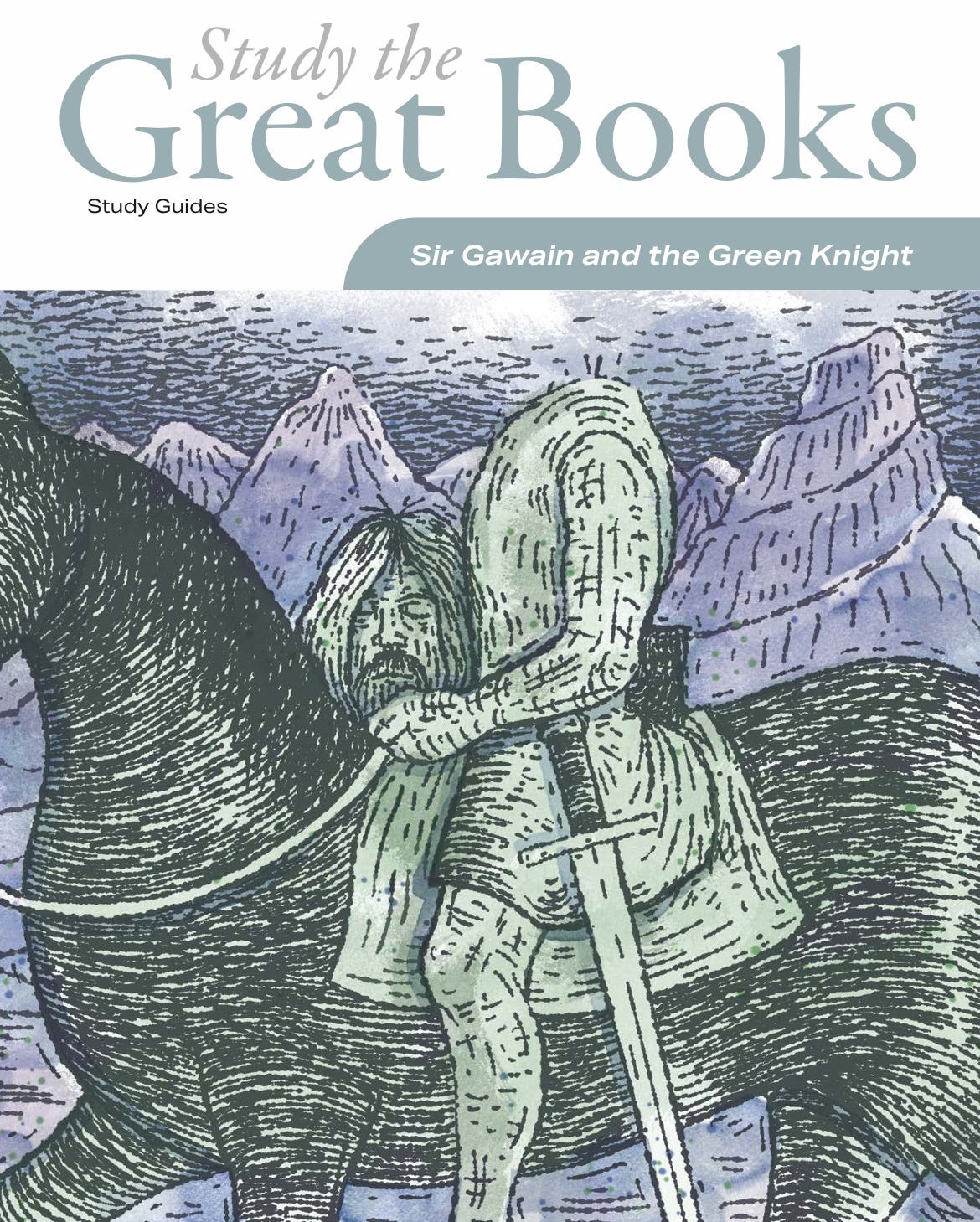
I lied, one more point of comparison. We have Joe Willey who is hand drawing all of our covers for our Study Guides and Annotation Editions of the books we are publishing. Memoria Press is at a definite loss because they don’t have Joe!
For $5 a month you can gain access to STGB’s Humanities curriculum as we are building it, long before it makes it to our finalized print editions! Whether you are just interested in learning yourself, or you are homeschooling your kids, or you are a teacher in a classical Christian school, or maybe you are leading a book club in your church or community, we have the resources to help you! All for less than the price of a single Starbucks coffee once a month.
Nicely done! Jacques Barzun would have some things to say about blending subjects :-)
This is actually one of my favorite points of comparison among authors/publishers in the modern recovery of CCE.
In my view, integration is really the backbone of any classical approach.
Great article. I love detail; feed me with a hose and let me decide what I can take in. I also love the addition of more than vocabulary. Geography, people etc, so lovely. As a person educating my children and myself through the great books of the Western tradition while not being from another tradition I appreciate intense handholding that doesn't undermine my own thinking and grappling with a text. Thankful that your guides seem to do that. The breakdown of grammar, logic and rhetoric for the comprehension questions is also very helpful for those of us who are amateurs in the classical tradition. I hope we can afford this in a year or so when we enter the 7th grade.